 Dr. John Rutledge
Tough first day at work. April inflation 4%. Growth fading. The FOMC meets in 3 weeks. Politicizing the Fed would be a disaster. It won't take long for us to learn which team he's playing for.
Personal note: I first met Kevin Warsh in the Roosevelt Room of the White House in 2002. He was a young staffer working for George W. Bush. I was there to walk President Bush through work I had done to estimate the impact of his proposed dividend tax cut on the economy and the stock market. Kevin introduced himself and asked me give a short briefing to the press after the meeting. I remember him as a smart, energetic, and kind young man. Later, when W. appointed Kevin to fill a vacancy on the Federal Reserve board, I recall thinking he was too young for the job but he got plenty of on the job training saving the world and bailing out the banks during the 2008 financial crisis. I have only good wishes for him in his new assignment, admittedly a little restrained by worries that he was appointed by a President who has made it clear he wants the Fed to lower interest rates and whose close friend is Kevin’s father-in-law. The stakes couldn’t be higher. If the Fed were to fall into the hands of the politicians we would lose our last institutional anchor on the U.S. price level and you could kiss Fed inflation targets goodbye.
Summary: Kevin Warsh was sworn as Fed Chairman on Friday. Yesterday was his first day at the office. But there’s no time for a honeymoon. April inflation was 4%. The world is sinking into recession. That giant sucking sound you hear is our oil and gas reserves running dry. Ukraine is blowing up Russian refineries every day. Much of the energy infrastructure in the Gulf has been destroyed. And the only two spots in the world that should be called real rare earth—the Straits of Hormuz and the land under TSM’s headquarters in Taiwan—are both in play thanks to the man who appointed him to the job.
The FOMC meets in 3 weeks to set interest rates. Will Kevin push to raise rates to fight inflation, which would please the bond market? Or will he lower rates to protect jobs, which would please the White House? If history (the 1979 OPEC embargo) is a guide, the answer will have a major impact on the November elections. It won’t take long to find out which team he is playing for.
Brace yourself for wild swings in bond, stock, currency, and commodity prices in the coming weeks as this story plays out.
My advice to Kevin: remember that the Fed doesn’t print oil and that no interest rate decision will tame inflation or boost growth today. The Fed influences demand but has no control over supply. Both rising inflation and fading growth were caused by the Iran war, which has shut off critical access to oil, gas, fertilizer, and critical commodities for every country in the world. He should use whatever influence he has with the President to press the case that a quick end to the Iran War would be good for the economy and good for Trump’s prospects in November.
Opening the Straits of Hormuz to shipping, and allowing the 800 ships trapped in the Persian Gulf safe transit would do more to solve both inflation and growth than anything the Fed could do. But he has to do it now. It will take several months to restore some sense of normalcy to global energy and commodity supply chains; the capacity that has been destroyed and will never come back. And the November elections are only 5 months away.
While you are there, you can also mention that removing tariffs, restoring trade, and delivering the defensive weapons that we already sold to Taiwan and Japan would help on both counts too.
Inflation is already 4%
Last week the Treasury issued 30 year bonds with a 5% coupon for the first time since 2007 because, as the Financial Times wrote over the weekend that “investors believe the inflation rate in a year’s time could be 4 percent.”
Fun fact: April inflation was already 4%, more than double the Fed’s 2% target. May inflation will be higher still.
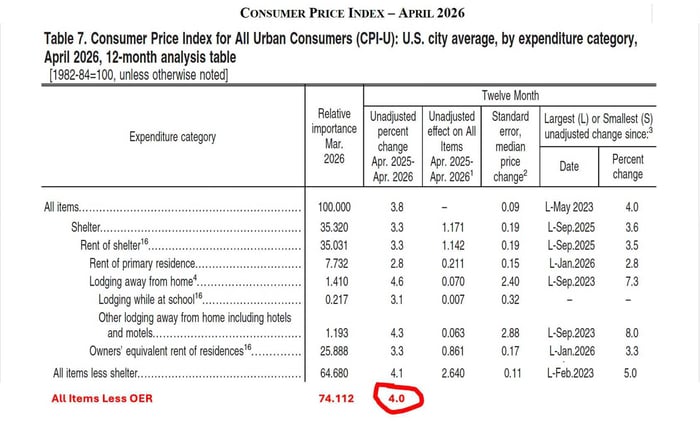
As I have written before, there is a fatal flaw in the market basket of goods and services used to construct the CPI index. Rent of primary residence—the actual checks that people pay to their landlords—makes up just 7.7% of consumer spending, as shown in the table below, because two-thirds of the people in the U.S. own their own homes, a third of which own their homes free and clear with no mortgage, another third own their homes with a mortgage rate less than 4%.
But the Labor Department puffs that 7.7% Rent of primary residence number up to a measure they call Rent of shelter, 35% weight in the CPI index, by adding an imaginary figure they refer to as Owners’ equivalent rent (OER) that purports to measure what people who live in their own houses would have to pay in rent every month if they had to rent their own homes from themselves at market rates. (I’m not making this up.) That sleight of hand is the reason the Fed underestimated inflation during the first two years of COVID—they called it transitory inflation—and overestimated inflation in 2023-2024, leading to policy errors in both cases.
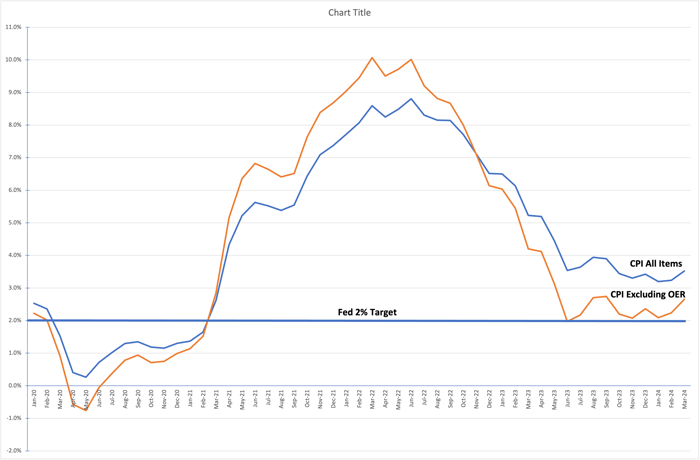
OER caused the Fed to underestimate inflation in 2021-2022 and overestimate inflation in 2023-2024. Both led to policy errors.
A quick calculation of consumer prices, after removing the bogus OER from the index using the weights provided in the table below, shows that the right measure of April consumer prices—All items less OER—was 4.0% higher than a year earlier.
Prices up, growth down in May
That 4% corrected figure for April includes the direct impact of the 15% increase in energy costs during the first two months of the war, but not the impact on the prices of everything else as the spikes in oil, gas, and commodity prices work their way through the rest of index. But we can catch a glimpse of it from the S&P Global Flash PMI report released last Thursday (the day before Warsh was sworn in) titled “subdued growth in May amid price surge”. You can see for yourself in the charts below.
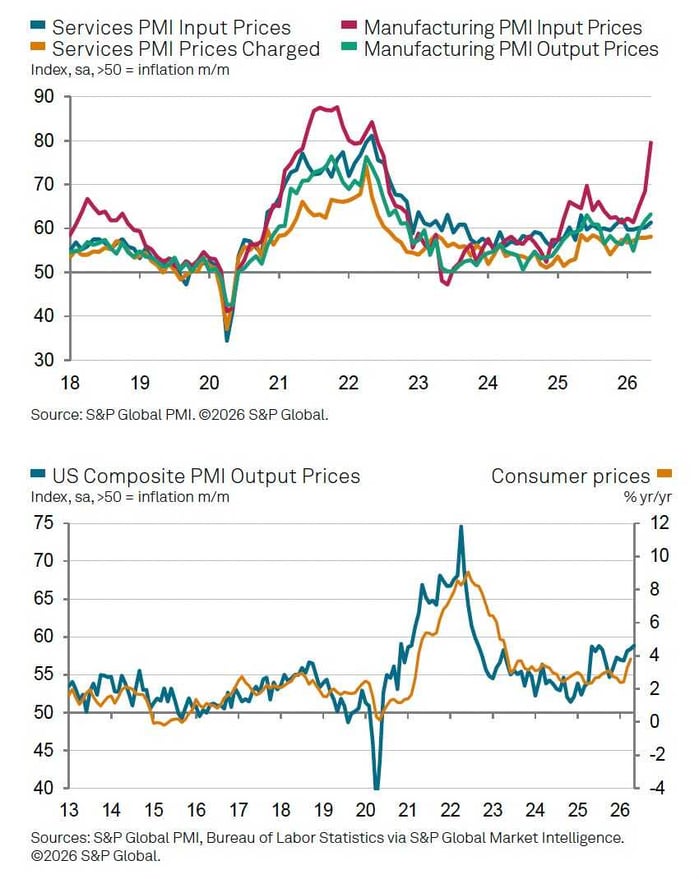
The spike in Input Prices (oil and gas) is working its way through the economy.
This price spike is a supply-chain story, of course, reminiscent of what we saw during COVID. Factories, already reporting lengthened supplier delivery times and lead times due to tariff impacts, are stockpiling input materials.
The supply-chain story is showing up in growth too. Overall employment in May fell, as sharply falling service sector jobs were partially offset by a temporary bump in manufacturing jobs as manufacturers staff up to fill precautionary stockpiling orders. Overall, the May numbers are consistent with Q2 GDP growth that has slipped to about 1% annual rate and will weaken further in the second half. The same story, of course, is playing out everywhere else in the world as China, India, Japan, and Germany all struggle to operate with less oil and gas.
Home prices don’t show it yet
The rise of inflation hasn’t hit the stock market yet, in part because home prices are still subdued. The sales price of an existing home in March was $412,400, just 1.3% higher than a year earlier. As students of Asset-First Economics know, asset prices are driven by comparisons of returns on tangible assets, like real estate, and returns on financial assets, like stocks and bonds. Low home price inflation, which makes up the lion’s share of household net worth, have made financial asset returns look more attractive to investors. Rising inflation will soon put an end to that. So far, the bond market has gotten the message. The stock market will be sure to follow.
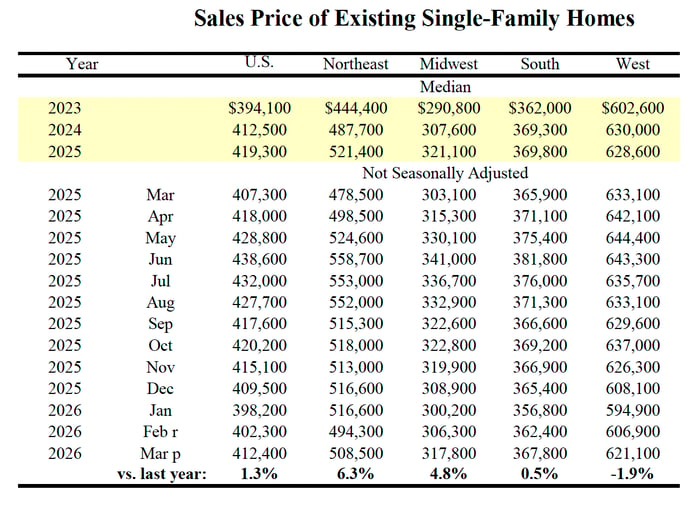
Existing home prices in March were just 1.3% higher than a year earlier.
There is no K-shaped economy
All this is taking place in a place where the fortunes of one group of people are diverging sharply from the fortunes of everyone else. As the chart below shows, people who make their living in the stock market are doing just fine; people who make their living in the job market not so much.
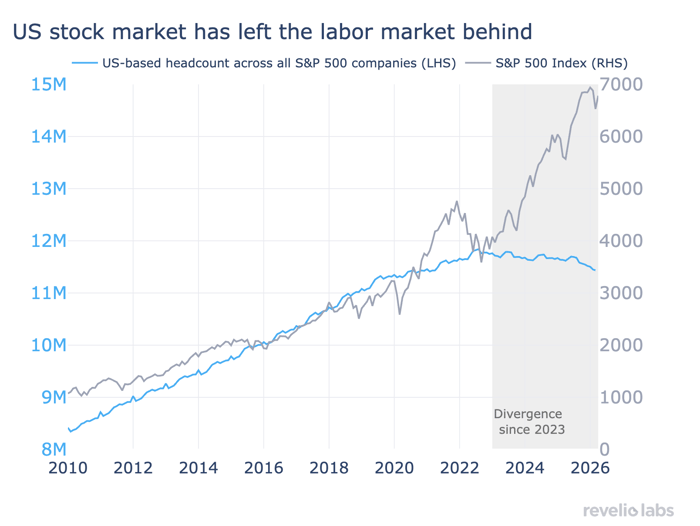
There is no K-shaped economy. There are two economies. You are either a passenger on one or the other.
The people who call this the K-shaped economy are missing the point. There is no K-shaped economy. There are two different economies. You can think of them as different ships and of the people as passengers on either one ship or the other. One ship is the balance sheet economy where success is measured as net worth. The other is the paycheck economy where success is measured by whether you have a job and how much you get paid. As the chart below shows, they have been sailing different courses for some time.
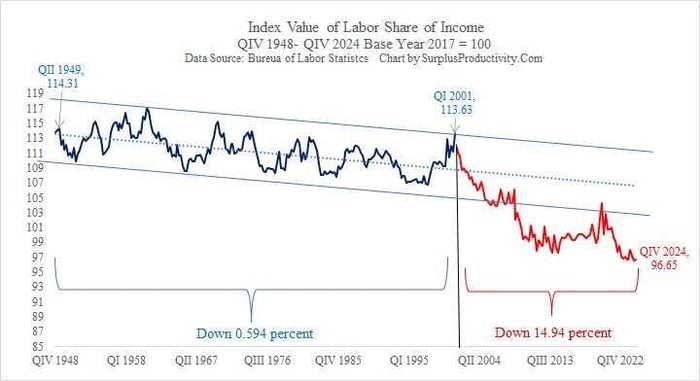
Labor’s Share of Income has declined sharply over the past 25 years.
The most telling metric, however, is Labor’s share of income, the percentage of total income that goes to people collecting a paycheck, with the rest going to people who collect rent, royalties, dividends, or capital gains.
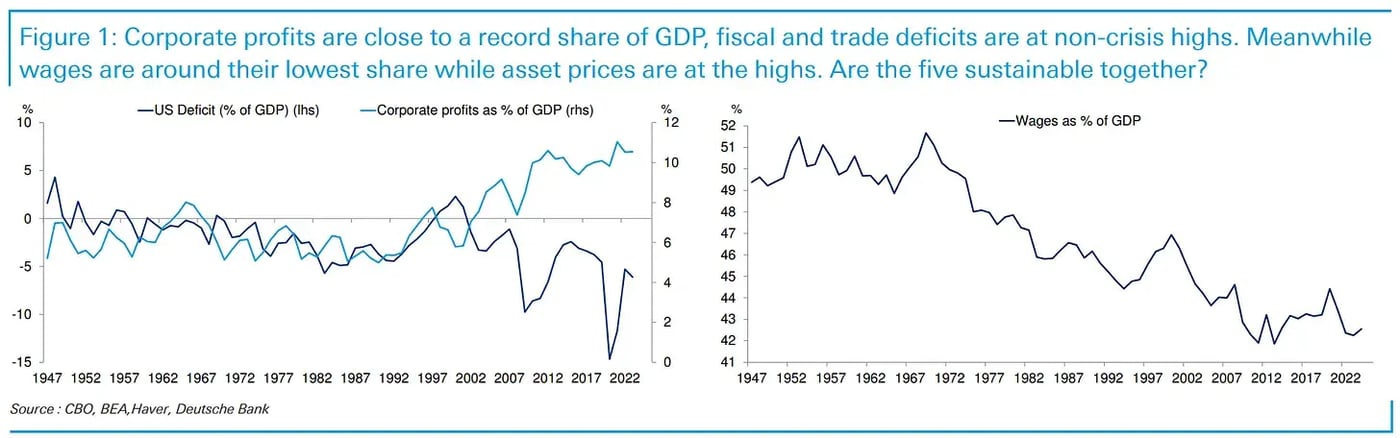
Labor share has declined during most of the postwar period, but the decline has accelerated since the millennium. I believe this change in labor share is the root of much of the political instability we are dealing with today. I am convinced that the increasing returns nature of businesses in the rapidly growing information sector is driving both the decline in labor share and the increasing concentration of stock market returns. I’ll write more about that in the next post.
Thanks for reading Dr. John Rutledge: Asset-First Economics!