 Dr. John Rutledge
Asset-Based Economics, The Back Story
Tangible Assets, Complex Adaptive Systems, and Far From Equilibrium Economics
Engage the Podcast by clicking here
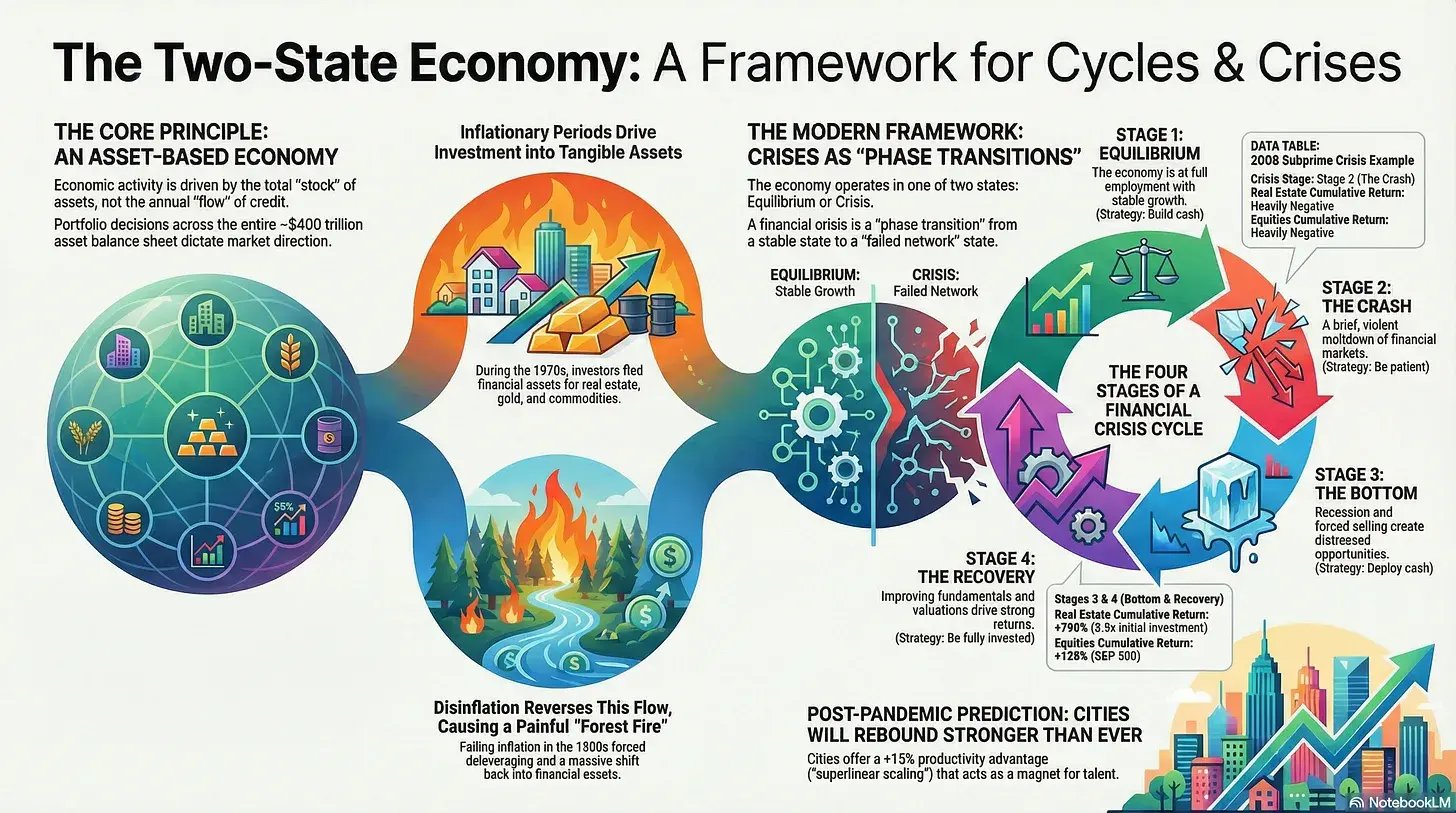
This is a graphical summary of mr Asset-Based Economics framework. The left side of the chart describes general equilibrium, the right side the phase transitions that occur far from equilibrium.
What is Asset-Based Economics?
Asset-Based Economics rests on two fundamental ideas.
The first is that balance sheets—both tangible and real assets—are too big to ignore. The official numbers put the U.S. balance sheet at $566 trillion balance sheet about nineteen times bigger than GDP, which is about $30 trillion per year. So it shouldn’t come as a surprise to learn that even a small disturbance in our balance sheet, say, when people change their minds about what they want to own, will swamp any change in spending, saving, or borrowing taking place in the GDP accounts. That’s why, to a first approximation, all big economic and financial market stories are triggered by balance sheet events.
The second idea is that the economy is a living, breathing, complex adaptive system in which observable events depend more on the interactions among people than on the so-called rational decisions of a utility-maximizing robot. Friedrich von Hayek taught us almost a century ago that a market economy is a vast and efficient communications network that transmits signals, using symbols called prices, about relative wants and scarcities to the people who need the information to make decisions about what to produce and what to consume. That market economy works very well most of the time but, like all networks, experiences occasional system failures, or blackouts. In investing, we call those cascading system failures “financial crises” when markets shift abruptly from price-clearing to nonprime rationing. The bad news is those situations are sudden, violent, and unpredictable. The good news is they are temporary.
Asset-Based Economics puts the two ideas together in a framework that focuses on balance sheets to understand both how economies behave when they are operating in a near equilibrium state and when they are operating in a state far from equilibrium.
And thank you for reading and listening. Engage the Podcast by clicking here
Dr. John