5 min read

Asset-Based Economics, The Back Story

Asset-Based Economics, The Back Story

Tangible Assets, Complex Adaptive Systems, and Far From Equilibrium Economics


Summary: This post serves three related purposes. First, it gives a short history of Asset-Based Economics, the analytical framework that I have built over the past 45 years to repair what I view as structural weaknesses in standard textbook macroeconomics. Second, it is an experiment in using a new audio technology, in the form of a podcast, to augment the video series I am producing for Safanad. Third, it is a request for questions, comments, and advice from my readers about what you would like to see in this series. Hope you enjoy and look forward to hearing from you.

But first, I want to say Merry Christmas and thank you to all of the people who have read my work and contributed ideas in so many ways since my first piece was published 53 years ago. You are truly the reason why I write.

Watch the full video here

What is Asset-Based Economics?

In many ways, Asset-Based Economics is a summary of my professional life’s work. I have been building, testing, and refining it, and using it to restructure corporate balance sheets and manage investment portfolios since I was a graduate student in the early 1970s. I’m about halfway through writing a book about the ideas and my adventures along the way to discovering them. I’ll post the chapters one by one here on substack and on the Safanad website as they are complete.

The driving force behind all of my work was the cognitive dissonance I experienced when comparing textbook macroeconomics with what I was seeing in the real world. They just didn’t match.

1d763e57-438b-48ab-a45e-18e5985ab11c_2752x1536

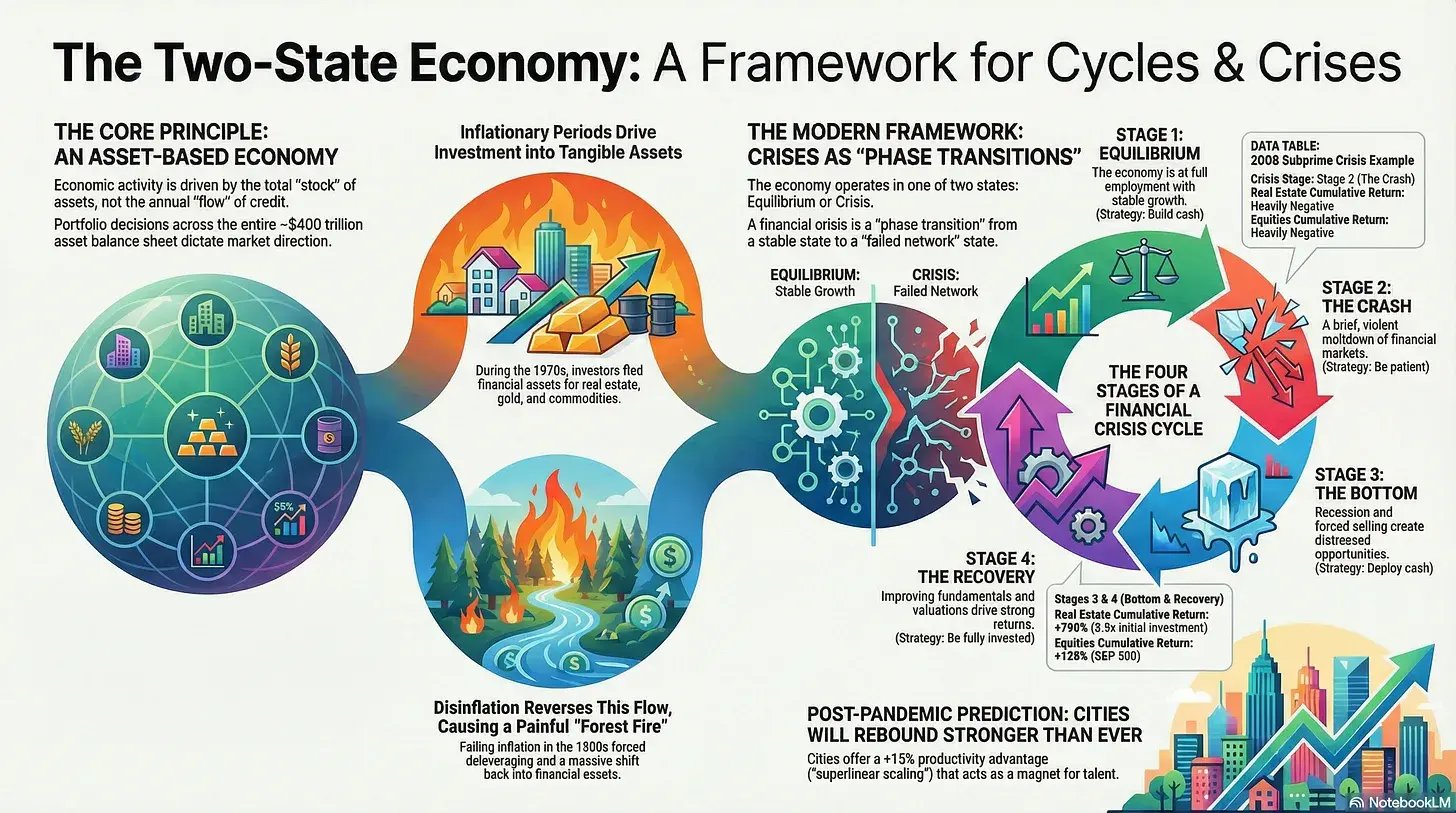
This is a graphical summary of mr Asset-Based Economics framework. The left side of the chart describes general equilibrium, the right side the phase transitions that occur far from equilibrium.

Asset-Based Economics rests on two fundamental ideas.

The first is that balance sheets—both tangible and real assets—are too big to ignore. The official numbers put the U.S. balance sheet at $566 trillion balance sheet about nineteen times bigger than GDP, which is about $30 trillion per year. So it shouldn’t come as a surprise to learn that even a small disturbance in our balance sheet, say, when people change their minds about what they want to own, will swamp any change in spending, saving, or borrowing taking place in the GDP accounts. That’s why, to a first approximation, all big economic and financial market stories are triggered by balance sheet events.

The second idea is that the economy is a living, breathing, complex adaptive system in which observable events depend more on the interactions among people than on the so-called rational decisions of a utility-maximizing robot. Friedrich von Hayek taught us almost a century ago that a market economy is a vast and efficient communications network that transmits signals, using symbols called prices, about relative wants and scarcities to the people who need the information to make decisions about what to produce and what to consume. That market economy works very well most of the time but, like all networks, experiences occasional system failures, or blackouts. In investing, we call those cascading system failures “financial crises” when markets shift abruptly from price-clearing to nonprime rationing. The bad news is those situations are sudden, violent, and unpredictable. The good news is they are temporary.

Asset-Based Economics puts the two idea together in a framework that focuses on balance sheets to understand both how economies behave when they are operating in a near equilibrium state and when they are operating in a state far from equilibrium.

So, I decided to put a full description of this framework down on paper to share with readers. The problem is how to do it. I have an entire bookcase filled with 1200 or so books and articles I have written about these ideas over the past 50 years. The audio recording above is a start at telling the story.

The Podcast technology

The podcast, attached, is a first attempt at putting together a history of the ideas. I produced it by uploading a half dozen of my own articles that I wrote over the years along with an excerpt from Bob Bartley’s Seven Fat Years that describes how my early work fit into the policy and Wall Street environment at the time I wrote them. I used Google’s Notebook LM AI software to summarize the articles and convert them to a podcast format where two hosts talk about the ideas. The only thing I will say about the technology, other than the fact that is very fast and very amazing, is that 1) to my reading it did an extremely accurate job summarizing the ideas, and 2) it treated both me and my ideas with kindness and respect, perhaps even more than deserved.

I have listed the articles I uploaded to make the piece below along with links to the articles in case you would like to read the originals. And you can see my related videos on the Safanad Chief-Strategist page. Hope you enjoy.

Historical Articles Used in the Podcast

 I gave Notebook LM 6 PDF files.

  1. Wall Street Journal Op-Ed, December 14, 1981, “Why Interest Rates Must Fall in 1982.”

    In this Op-Ed, I argued that the debate raging on Wall Street, whether or not there would be enough savings to finance the budget deficit without increasing interest rates, was wrong. Interest rates, and all other asset prices, will be whatever they need to be to make people willing to own the stock of existing tangible and financial assets. The inflation rate that matters for interest rates is real Asseet inflation, not the CPI. Inflation was already headed lower. Interest rates must fall.

  2. New York Times Op-Ed, June 20, 1982, “Ghost Town.”

    In this Op-Ed, I pointed out that corporations and households had loaded up their balance sheets with inflation hedges and tax shelters during the late 1970s, that they would be lining up to unload those assets to restructure for low inflation, and that the resulting drop in real asset prices would cause irreparable damage to many companies.

  3. Wall Street Journal Op-Ed, August 4, 1983, “The Structural Deficit Myth.”

    In this Op-Ed, I suggested that the “Structural Deficit” that worried many on Wall Street was a monster under the bed and that interest rates would continue to fall.

  4. Financial Times Op-Ed, October 25, 1985, “The Forest Fire of Disinflation.”

    In this Op-Ed, I described a rolling real asset deflation process in which the restructuring activities of some companies can lead to asset price changes that force other companies to follow suit, leading to a decade of restructuring.

  5. Robert Bartley, 1992, Seven Fat Years, pp. 125-128.

    This is Bob Bartley’s classic book on the history of the Reagan Economic Plan that Larry Kudlow and I helped create and show it worked its way through the economy. The pages I uploaded contain Bob’s thoughts on the contrast between my interest rate analysis and the dominant flow of funds approach used on Wall Street by Dr. Doom and Mr. Gloom.

    Bob was the editor of the Wall Street Journal for many years, won a Pulitzer Prize, and received the Presidential Medal of Freedom from President George W. Bush in 1983.

  6. Safanad. “The Impact of COVID on Urban Real Estate.” “Part 1 of 2: COVID and Urbanization. Cities hit hard by COVID. Review of historical, Economic and Scientific Literatures”, and Part 2,” and “Part 2 of 2: COVID and Cities. Investment Strategy.”

    This is a piece I wrote for Safanad that reviews the academic literature in both economics and physics on the resilience of cities, my analysis of the 2008 subprime mortgage crisis, and how an economy works through the multi-state dynamics following a cascading network failure. This is my best attempt to describe the economy as a complex adaptive system and credit crises as phase transitions. It also contains estimates of which investment strategy performs best in each phase of the process.

Help Please

OK, now to the please help part. It’s clear to me that many readers/viewers prefer to engage with ideas in short audio or video format but I am not sure how many or what would be the most helpful format. I am experimenting with both audio and video podcasts where I have a conversation with a friend/host on topics of interest to subscribers rather than an AI generated podcast produced from my written work. It would help me a lot if you would send me a comment with your opinions on how you would best like to see the information delivered.

And thank you for reading and listening.

Dr. John